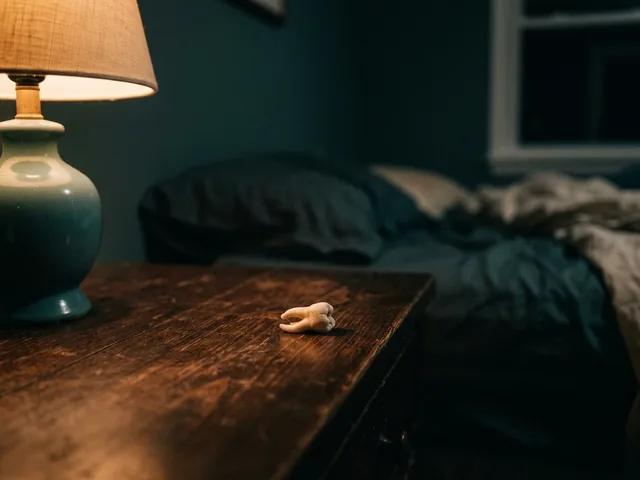
Dreaming that your teeth crumble, loosen, or fall out is one of the most common dreams in the world, and it almost never has anything to do with teeth. It usually appears when you fear losing face, losing control, or losing a version of yourself that is quietly coming to an end.
Why this dream is so common
Teeth sit at the center of how we present ourselves. We show them when we smile, we use them to speak clearly, and we judge health and attractiveness by them. When the unconscious wants to say something about self-image, confidence, or the ability to express yourself, teeth are the most natural symbol it can reach for. That is why this dream shows up across cultures, ages, and centuries: the anxiety it encodes is universal.
Studies of dream content consistently place teeth dreams among the most frequently reported themes, alongside falling and being chased. Frequency is a clue in itself. The dream tends to cluster around moments of evaluation and change: a new job, a breakup, public speaking, aging, money pressure, or any period when you feel watched and judged.

The Jungian view: losing the mask
Carl Jung saw dreams as compensation, the psyche balancing what the waking mind ignores. In that frame, teeth belong to the persona: the polished face we maintain for the world. When teeth fall out in a dream, the persona is failing. Something you have been holding together for an audience, competence, composure, youth, certainty, is slipping, and the dream makes you feel it viscerally instead of letting you keep pretending.
That sounds like bad news. Jung would say it is the opposite. A crack in the persona is often the beginning of individuation, the process of becoming who you actually are rather than who you perform. The dream is not predicting collapse. It is telling you where the performance has become too expensive.
Freud, for what it is worth, read teeth dreams differently, tying them to repressed drives and anxieties about the body. Modern dream psychology tends to side closer to Jung: the strongest correlations are with waking stress about appearance, competence, and transition.
Common variations, and what they tend to suggest
- Teeth crumbling to pieces. Something that once felt solid, a plan, a relationship, an identity, is disintegrating gradually rather than breaking at once.
- Spitting teeth into your hand. You can see the loss clearly and are holding the evidence, but have not yet said it out loud. Often about unspoken words.
- Teeth falling out in public. The fear is specifically about being seen losing control. Check where in your life you feel most watched right now.
- One loose tooth you keep touching. A single commitment or belief is wobbling, and your attention keeps returning to it. The dream mirrors the compulsion.
- Swallowing a tooth. A loss you are trying to internalize quietly instead of acknowledging. Ask what you are trying to make disappear.
Questions to ask yourself
A symbol dictionary can only tell you what teeth mean in general. The real meaning lives in the overlap between the dream and your week. Sit with these:
- Where in my life am I afraid of being seen as less capable than I appear?
- What am I holding together right now that costs me real effort to maintain?
- Is something ending, a role, a relationship, a chapter, that I have not admitted is ending?
- What did I not say this week that I needed to say?
- How did I feel in the dream: panicked, ashamed, relieved? The feeling is the message.
When the dream keeps coming back
A one-off teeth dream is a snapshot. A recurring one is a pattern, and patterns are where dreams get genuinely useful. If you write the dream down each time it returns, with the date and what was happening that day, the trigger usually becomes obvious within a few weeks: the dream that arrives before every performance review, or after every call with a certain person.
This is exactly what UnderSelf is built for. You speak the dream the moment you wake, before it fades. The app transcribes it, gives you an interpretation grounded in your own history rather than a generic dictionary, and tracks the symbol across time so recurring themes surface on your Inner Map. The tenth teeth dream tells you far more than the first, if someone is keeping count.
Download UnderSelf for iOS or get it on Google Play and record the next one before breakfast.
No download needed: tell this dream to UnderSelf in your browser and see what it says about you.
Frequently asked questions
Is a teeth falling out dream a bad omen?
No. Dream research finds no link between teeth dreams and future events. The dream reflects how you feel now, most often about self-image, control, or a transition you are living through. It is information, not prophecy.
Why do I keep having the same teeth dream?
Recurring dreams tend to return while the situation that fuels them stays unresolved. If the teeth dream repeats, something in waking life is still asking for your attention. Tracking when it recurs, and what happened that day, usually reveals the trigger.
Does the dream mean something is wrong with my health?
Usually not, and a dream is never a diagnosis. Some researchers note that real dental tension, like grinding your teeth at night, can feed into the imagery. If your teeth actually hurt, see a dentist. For everything else, the dream is better read psychologically.
What if only one tooth falls out in the dream?
Smaller losses in the dream often mirror smaller stakes in life: one commitment, one relationship, one role that feels loose. Total collapse of all teeth tends to appear when the whole self-image feels in question. Your feeling in the dream is the best guide.
Related: what dreams about snakes really mean, what blood in a dream means, and what dreams about your hair falling out really mean.
UnderSelf offers reflective interpretation, not medical or psychological advice. If a dream connects to distress that will not lift, a licensed professional is the right next step.