UnderSelf editorial desk · 29 September 2026
Dreaming about an earthquake is rarely about the earth. It usually means a foundation you relied on, a home, a job, a relationship, a belief about yourself, has started to shift under you. The ground is the one thing you never think about until it moves, and that is exactly the feeling the dream is pointing at: something you built your life on turning out to be less solid than you assumed.
What matters is what the shaking did. A building that fell, a crack that opened, a room that held, a person you ran to: each describes where the instability is and how you are meeting it. That is the part no dictionary can answer for you.
Tell UnderSelf the earthquake dream the way you'd tell a friend. It reads what is shifting in your life, not a stock definition of disaster.
Try a free reading →No signup for the first read. How it works.
Why an earthquake, of all the disasters a dream can stage
Every disaster dream has its own grammar. A tornado is visible on the horizon, so it tends to carry worry you can see coming. A tsunami is emotion arriving all at once. A fire burns something away. The earthquake is different from all of them: it comes from underneath. Nothing in the sky warns you. The danger is the very thing you were standing on.
That is why earthquake dreams cluster around a particular kind of waking change. Not a new threat arriving from outside, but a support you took for granted starting to give way. A company you assumed was stable announcing layoffs. A parent who was always the strong one suddenly needing help. A relationship you considered settled developing a crack. A belief about yourself, that you are the capable one, the healthy one, the one who does not need anyone, no longer holding.
In each case the shock is doubled: something is changing, and the thing that is changing is the thing you were using to steady yourself through change.

The psychology: the ground you stand on
The psychiatrist John Bowlby, who founded attachment theory, described the importance of a secure base: the people and places that let us venture out into the world because we know they will hold (attachment theory). Most of us do not notice our secure base, the way we do not notice the floor. An earthquake dream is what the mind produces when that base shifts. Its message is less "danger" than "the thing that made danger bearable is moving."
Carl Jung gives the dream a vertical dimension. In Memories, Dreams, Reflections he describes a dream of a house with many floors, which he explored downward from the furnished upper rooms to an ancient cellar and a cave beneath it, and which he came to read as a map of the psyche, layer under layer. Earthquakes happen where layers meet. In that frame the dream is not only about the ground shifting but about what lies beneath coming up to the surface: older feelings, older patterns, a foundation laid long ago that is now being tested.
Antti Revonsuo's threat simulation theory (Behavioral and Brain Sciences, 2000) offers a third reading: frightening dreams as rehearsal, the sleeping mind running a survival scenario so the waking self is readier. Many earthquake dreams are exactly that: find the doorway, get under the table, get the others out. The drill often says something useful about how you react when the ground moves, whether you freeze, run, or take charge.
And for some people the earthquake is simply real. After the 1989 Loma Prieta earthquake, researchers found that students in the San Francisco area reported more nightmares, including many about earthquakes, than a comparison group far from the quake (Wood and colleagues, Journal of Abnormal Psychology, 1992). G. William Domhoff's work on the continuity of dreams with waking life points the same way (The Quantitative Study of Dreams): if earthquakes are part of where you live, they will be part of how you dream.
What the shaking did
The damage in an earthquake dream is usually the most specific clue it offers. Notice what fell and what held.
Your own home shaking points inward. The house in dreams tends to stand for the self, so a quake in your home tends to mean the instability is personal: your sense of who you are, your private life, your family. The room matters too. A shaking kitchen touches daily care and nourishment. A bedroom, intimacy and rest. A basement, the oldest and most hidden layers.
A workplace, a school, a public building collapsing points at the institutions and roles you lean on. A job, a career path, a community, a set of rules you have lived by. These dreams often arrive when an outside structure is changing in a way you cannot control.
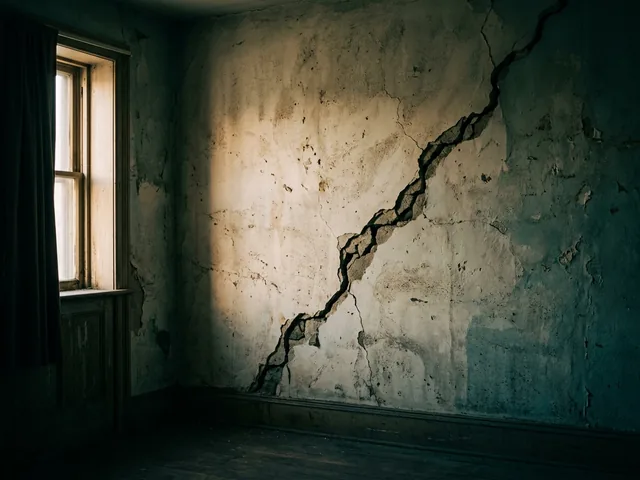
The ground itself opening is the dream's most direct image for something underneath breaking through. A buried feeling, an avoided fact, a conflict under the surface of a relationship, now too wide to step over.
Common variations, and what they tend to suggest
- Feeling the first tremors. A shift you are just beginning to sense. Often arrives before anything has visibly changed.
- A building collapsing around you. A structure you relied on giving way. Ask whose building it was.
- The ground opening beneath you. Something hidden rising to the surface, or fear of falling into it.
- Surviving unharmed. Upheaval you already know you can get through. Often one of the more reassuring dreams to wake from.
- Trying to save others. Responsibility for how a shared change lands on the people around you, and sometimes a question about who is holding you.
- Being trapped in rubble. Feeling stuck under the weight of what fell: an ending that has left you unable to move yet.
- Aftershocks, again and again. A change that keeps delivering new jolts after you thought it was over.
After the shaking stops
Many earthquake dreams end the way real ones do: in a strange quiet, dust settling, the dreamer standing in a changed room. That ending is worth as much attention as the quake itself, because it shows what your mind expects to find on the other side of the change.
Some people wake in the rubble, still trapped, and the dream leaves them there. That usually means the shift is fresh and nothing has been rebuilt yet. Others find themselves walking through the damage, taking stock, already sorting what can be saved. That is the mind moving from shock to assessment, often a sign the waking self is further along than it feels. And some dreams skip ahead to rebuilding: new walls, a different floor plan, a house that is not quite the one that fell. Those are among the most hopeful dreams in this family. They suggest that some part of you has already begun to imagine a life built on different ground, and that the foundation you lost may not have been the only one available.
If your dream ended while the ground was still moving, try finishing it while awake. What would you do first once it stopped? The answer is often a practical first step.
What this dream is not
An earthquake dream is not a prediction of an earthquake, and it is not a sign that something terrible is about to happen to you. Dream research finds no reliable link between disaster dreams and real disasters. The dream tracks your inner ground, not the ground under your city.
If you have lived through a real earthquake, the dream may be memory rather than symbol: the mind returning to an experience it is still processing. That is common, and it often fades with time. If the dreams keep returning or leave you shaken through the day, a licensed professional who works with trauma is the right person to talk to.
Questions to ask yourself
A dictionary can tell you what earthquakes mean in general. The meaning that matters lives in the overlap between the dream and your actual week. Sit with these:
- What in my life have I been treating as solid ground that has started to move?
- Whose building fell in the dream: mine, my family's, my workplace's?
- What held? What in my life is still steady, even now?
- Did something come up from underneath: an old feeling, an avoided fact?
- What did I do when the shaking started: freeze, run, protect someone?
- Who is my secure base right now, and have I told them the ground is moving?
When the earthquake keeps returning
One earthquake dream marks a shift. A recurring one usually means the shift is still underway, or that aftershocks keep arriving. Write each dream down with the date and what happened that day, and within a few weeks the pairing tends to show: the tremor after every conversation about the move, the collapse in the week of each round of news from work. The dream's timing is often the name of the fault line.
UnderSelf is built for exactly this. You speak the dream the moment you wake, before it fades. The app transcribes it, interprets it in the context of your own history rather than a generic dictionary, and tracks the symbol across time on your Inner Map. Read together, a season of earthquake dreams usually shows where the ground is moving far more precisely than one ever could.
No download needed: tell this dream to UnderSelf in your browser and see what it says about you.
Download UnderSelf for iOS or get it on Google Play and let the next one leave a record.
Frequently asked questions
What does it mean when a building collapses in an earthquake dream?
Usually a structure in your life that you assumed would hold is under strain: a job, a family arrangement, a plan, a way of seeing yourself. Buildings in dreams are made things, so a collapse tends to point at something built over time rather than something natural. Notice whose building it was. Your own home points inward; an office or a school points at the institutions you rely on.
What does it mean to survive an earthquake dream unharmed?
Often the reassuring version. The ground moved, and you are still standing. These dreams tend to come when a real upheaval is underway and some part of you already knows you can get through it. Notice what you did after the shaking stopped: looked for others, surveyed the damage, walked away. That tends to mirror how you are meeting the change by day.
Is an earthquake dream about a real disaster fear or something else?
Usually something else, but not always. If you live in an earthquake zone, or have lived through one, the dream may be a real fear or a memory, and that is ordinary. Research after the 1989 San Francisco earthquake found students near the quake reporting more nightmares, including earthquake nightmares, than students far away. For most people, though, the earthquake is a picture of instability: a foundation in waking life that has started to move.
What does it mean when the ground opens up in a dream?
Something beneath the surface of your life has broken through. A crack in the ground often points at a hidden layer, an old feeling, a buried conflict, a fact you have avoided, that has become impossible to walk over. Whether you fell in, jumped clear, or looked down into it says a lot about how ready you are to face what is underneath.
What does it mean to dream about trying to save others in an earthquake?
Usually that you feel responsible for how a shared upheaval lands on the people around you: a family through a move, a team through a reorganization, a friend through a crisis. The dream can be honoring that care. It can also be asking who is looking after you while you look after everyone else.
Related: what tornado dreams really mean, what tsunami dreams really mean, what a house in a dream represents, and all dream meanings.
UnderSelf offers reflective interpretation, not medical or psychological advice. If a dream connects to distress that will not lift, a licensed professional is the right next step.